Published
- 8 min read
SampleCon 2026 Long Read Recap: Real Humans in the Age of AI

Why the Future of Market Research Still Starts with People?
This week here at SampleCon, so many have asked me a question that seems to be floating around every market research conference right now:
“If AI can generate synthetic respondents, simulate markets, and analyze massive datasets instantly — do we even need panels anymore?”
It’s a fair question.
After all, the last two years have been extraordinary. Large Language Models can now summarize research reports in seconds. AI agents can generate surveys, analyze open-ended responses, and build predictive models faster than most teams could even brief a project a few years ago.
And synthetic data — AI-generated populations designed to mimic real consumers — is quickly becoming one of the most talked-about ideas in research. That almost captured the whole agenda this week on the first day - Monday.
But here’s the paradox. The more powerful AI becomes, the more valuable real human behavior becomes, not less.
To recap this week, the energy here at the Ritz-Carlton Reynolds at SampleCon 2026 was nothing short of electric, crackling with the kind of high-stakes “what comes next” conversations that only happen when an industry is on the precipice of a genuine paradigm shift. I wrapped up an intense panel discussion with Andrew Moffatt of Qrious Insight and our host Oscar Carlsson—two industry veterans whose perspectives I’ve long respected—and our focus was clear: the urgent democratization of behavioral data. We are finally moving away from the era of data silos and guarded monopolies toward an open ecosystem where the true value of behavioral intelligence can be shared and scaled.
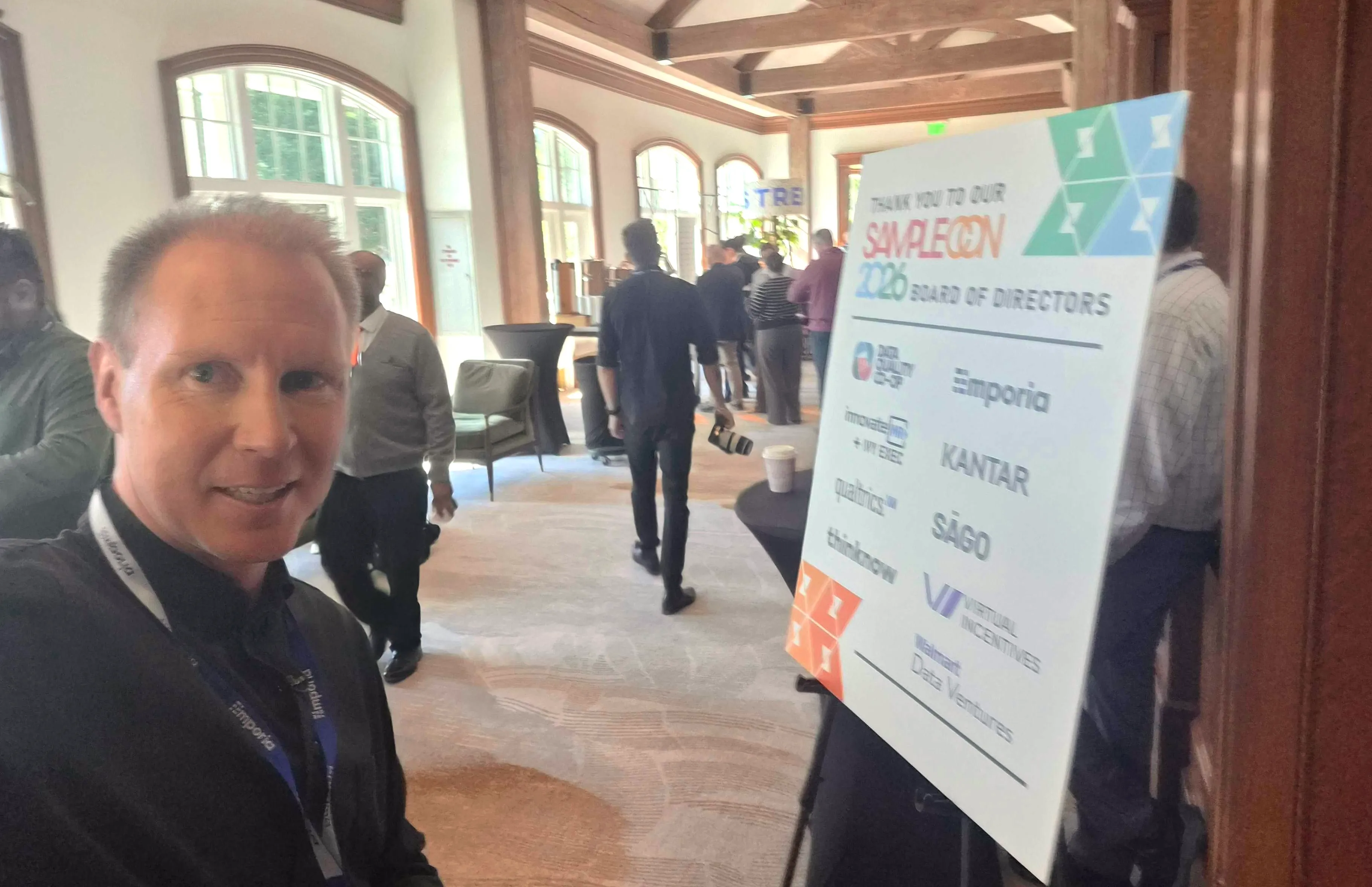
As I’ve often said, in a world increasingly flooded with synthetic simulations, verified human panels remain our most vital ground truth; behavioral data doesn’t replace the panelist, it makes their contribution richer, more continuous, and far more contextual. Bill Gates famously remarked that we tend to overestimate technological change in the short term while radically underestimating it in the long term. While the hype of the last two years hasn’t seen synthetic data replace the survey, the next 5-10 years will usher in a wave of automated, agentic AI models capable of generating insights in real-time.
To meet that future, we must rework the panel system from the ground up, bringing behavioral data to the broader market and ensuring that everyone in the value chain—especially the panelists themselves—participates in the upside of the intelligence they help create.
AI Is Transforming Research — But It Cannot Replace Reality
AI is going to transform market research. That part is obvious.
Research workflows that used to take weeks will increasingly happen in hours. Analysts will work with AI copilots. Data will be queried conversationally through chat interfaces. Complex behavioral datasets will be translated into insights that anyone can understand. This is incredibly exciting.
But there’s one fundamental constraint that AI cannot overcome: AI cannot invent reality. It can simulate it. It can interpolate it. It can extrapolate it.
But it cannot observe the world unless someone — somewhere — is measuring it. Markets are not abstract systems. They are created by real humans making messy decisions in messy environments.
People change their minds. They discover new products. They adopt technologies nobody predicted. They behave irrationally. They react emotionally.
No synthetic model can fully anticipate those things unless it is continuously calibrated against real human behavior.
In other words: AI can accelerate insight generation. But human behavior remains the ground truth.
Markets Are Built by People, Not Algorithms
If the purpose of market research is to understand what people need — how to design better products, create better experiences, and communicate more effectively — then the logic becomes very simple.
You cannot understand markets without understanding people. And you cannot understand people without observing their behavior in the real world.
For decades, the market research industry has relied heavily on one tool to do that: surveys. Surveys have been incredibly powerful. They allowed researchers to scale access to opinions and attitudes across millions of consumers.
But surveys have also always had a fundamental limitation. They rely on memory.
We ask questions like:
-
Which ads did you see last week?
-
Which apps did you use last month?
-
What brands did you consider before buying?
The honest answer for most people is: “I’m not entirely sure.” Human memory is imperfect. And as digital life has become more complex — with dozens of apps, platforms, and services competing for our attention — recall has become even harder.
Meanwhile, most of our decisions now happen inside digital environments: streaming platforms, e-commerce marketplaces, mobile apps, social networks and increasingly AI assistants. These environments generate continuous behavioral signals about what people actually do. Not what they remember. Not what they claim. But what they actually do. And this is where the next evolution of market research begins.

Panels Are Not Dying — They Are Becoming More Important
There’s a popular narrative floating around the industry that says: “Panels are dying.”
I don’t believe that, like I have stated on numerous occasions this winter. What’s true is that survey-only panels are under economic pressure.
Panel operators are facing:
-
rising acquisition costs
-
increasing respondent fatigue
-
declining survey CPMs
-
more fraud and automation
But the problem is not panels themselves. The problem is that panels have historically been monetized almost entirely on questions answered, not intelligence generated. That model made perfect sense in 2005. It makes much less sense in 2026. What’s happening now is something more interesting. Panels are evolving from survey distribution networks into behavioral intelligence platforms. Instead of simply asking people questions occasionally, panels can now observe real-world behavior continuously — with explicit consent and transparent value exchange.
Surveys don’t disappear. They become smarter and more contextual. Instead of asking a user weeks later what they remember doing, we can trigger a short survey at the moment a meaningful behavior occurs.
For example:
-
When someone abandons a shopping cart
-
When they switch streaming services
-
When they install a new fintech app
Suddenly, research happens in context.
The result is:
-
higher accuracy
-
higher engagement
-
better insights
And a better experience for participants. Panels become something more powerful than contact lists. They become living ecosystems of real humans.
Why Verified Humans Will Become the Most Valuable Asset
There’s another reason real panels will become more valuable in the AI era: Trust.
As generative AI becomes more sophisticated, the internet is increasingly filled with synthetic content, synthetic users, and automated interactions.
In a world like that, the real scarcity is not data. It’s a verified human reality. Panels — when operated correctly — provide exactly that. They represent communities of real individuals who have verified identities, established participation histories, and long-term relationships with panel operators
That creates something incredibly valuable: a trusted layer of human truth in a synthetic world. In fact, panels may end up playing a role far beyond traditional research. They can become part of the verification infrastructure of the digital economy. That kind of ground truth will only become more valuable as AI models become more widespread.
The Next Generation of Panels: Human Reality at Scale
As I reflected with many conference participants this week, so what does the next generation of panels actually look like? In simple terms, panels evolve from: “Respondent pools” into “behavioral ecosystems.”
Panelists still provide opinions and feedback. But they can also contribute passive behavioral signals from their digital environments — always with explicit opt-in and transparent data governance.
And because behavior is observed continuously, research becomes faster and more precise. Insights are no longer limited to quarterly reports or one-off studies. They become continuous intelligence streams.
This is where technologies like AI, cloud infrastructure, and modern SDK architectures are transforming what panels can do. Instead of running occasional projects, research platforms can operate more like real-time data systems.
And that unlocks entirely new possibilities.
The Pace of Innovation Is About to Accelerate
Like I stated in my speech at SampleCon, and briefly above, if we zoom out for a moment, the current moment in market research is fascinating. Online panels have existed for over two decades. The early pioneers — companies like Greenfield Online, OTX, and others — built the first large-scale digital respondent communities in the early 2000s.
That first generation of innovation took roughly 20 years to mature. The next generation will move much faster. Why? Because the enabling technologies already exist: global cloud infrastructure, advanced AI models, mobile-first data collection and real-time data processing
The combination of these technologies means that the next major transformation in market research will likely happen within two to five years. That’s not a distant future. It’s happening right now.
The Opportunity for the Industry
And this is why I remain incredibly optimistic about the future of market research.
Yes, AI will change how research is done.
Yes, new tools will automate many traditional workflows.
But the core mission of the industry remains exactly the same as it has always been:
understanding people.
What’s changing is the way we do it.
The future of research will combine three powerful elements:
-
real humans
-
behavioral data
-
intelligent AI systems
Panels will not disappear. They will become more sophisticated.
Surveys will not disappear. They will become more precise.
And behavioral data will provide the missing layer that connects opinions with reality.
At Behavix, this is exactly the future we’re working toward.
Not replacing surveys.Not replacing panels.
But helping the industry build the infrastructure that connects human behavior, modern technology, and real-time insights.
If we get this balance right, something interesting happens. Market research doesn’t become more abstract. It becomes closer to real human behavior than ever before. Closer to the moments when decisions actually happen. Closer to the environments where products are discovered. Closer to the messy, fascinating reality of how markets actually work.
And that, ultimately, is what our industry has always been about. Understanding people. Not perfectly. But a little better every day… Thanks everybody for this week at SampleCon 2026, looking forward to being back next year!

Co-Founder & CEO of Behavix